










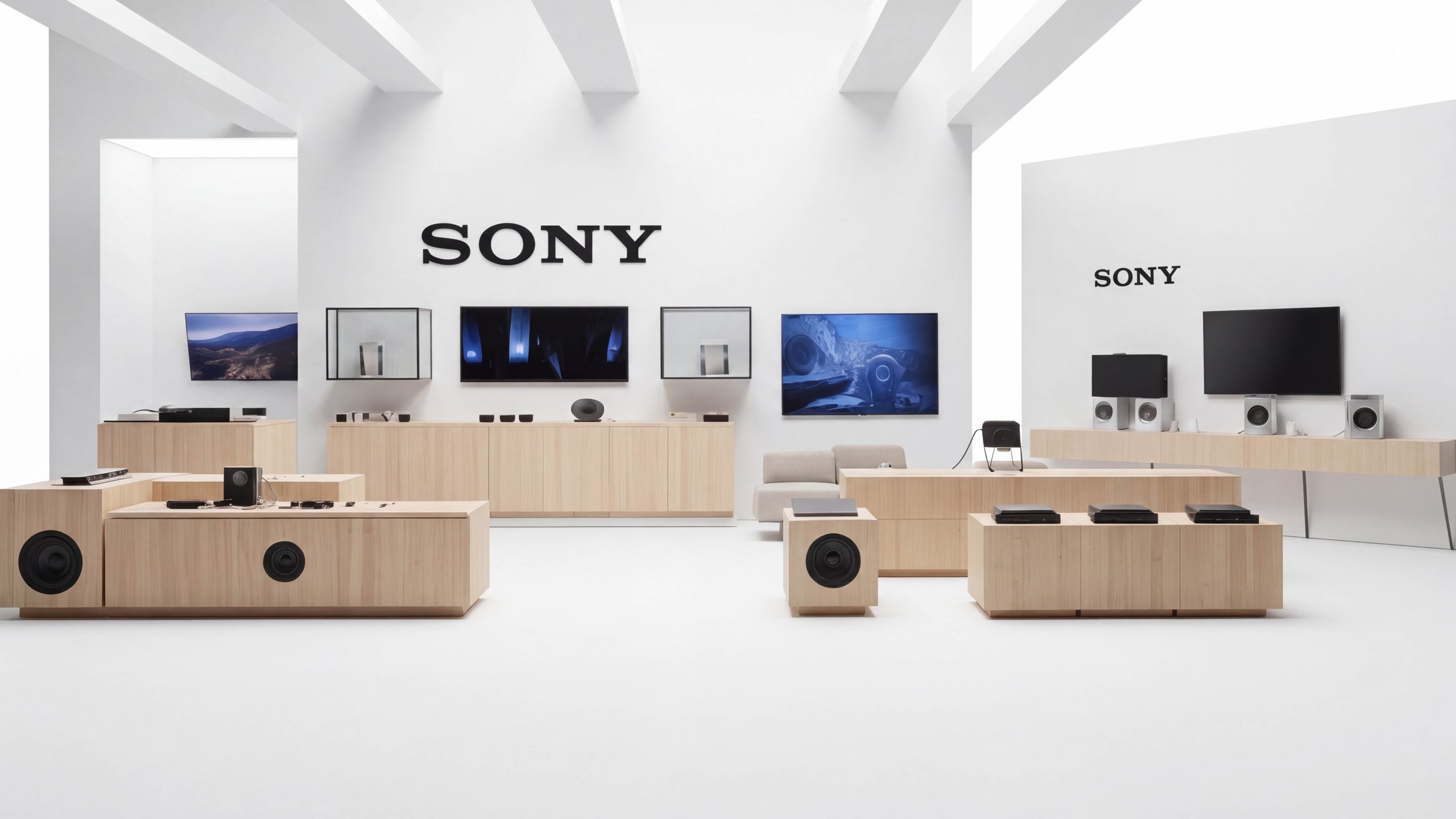
Sony retail and display wayfinding system. Settings include city flagship stores, standard shopping-mall stores and temporary exhibition stands.
The scope covers façade identification, lobby arrival, functional zones and the trial-island system, pricing and benefits information, checkout and pickup, after-sales service, accessibility and emergency wayfinding.
The goal: in a high-traffic, experience-driven, SKU-dense environment, build a wayfinding system that is replicable, low-maintenance and scalable. First-time visitors should gain a sense of direction within 30 seconds, returning customers should reach their target device in three steps, and stores should be able to run standardized operations with data-driven maintenance.

Assess the current state and define the goal
Site surveys and heat-map path analysis showed poor long-range visibility at corners; inconsistent operating and safety prompts across trial islands; a muddled hierarchy of price tags and benefits; temporary materials interfering with the core system; and bright screens and glass reflections impairing legibility. These findings defined three quantified objectives. Continuous guidance: advance notice and progress confirmation at 100% of key turns, with secondary confirmation every 12–15 m along long corridors. Stable legibility: a parameter library for viewing distance, type size, contrast and illuminance, keeping signage legible day and night and across multiple surface materials. Efficient operations: modular variable information, with 5–10-minute changeovers per store while staying consistent across stores.
Systematic Strategy and Coding System
One grid: a unified 8 pt / 4 mm module runs through both sign layouts and hardware tooling, reinforcing a consistent look across stores. Two viewing distances: long range (12–25 m) for storefront signage and category indexes; short range (1–7 m) for directions, specifications and policy information, each with defined minimum illuminance and contrast thresholds. Three carrier types: fixed signage (storefront, floor and zone signs, overview maps), variable information (price tags, featured products, installments/trade-in, demo schedules) and temporary guidance (peak-hour flow management, maintenance detours, emergency evacuation), all sharing a unified magnetic/slot-in interface. Four-level coding: store – zone – position – unit (letters + numbers); bundles and accessories use a “solution code + part number,” linked to inventory, picking, pickup and after-sales systems. Five-step implementation: survey and modeling – prototyping – pilot calibration – full rollout – handover of the asset register and SOPs.
Visual and information rules
Color: the brand’s deep black and cool gray form the environmental base, with white carrying information; functional accents come in electric blue and safety yellow, and accessibility information uses international-standard blue/white. Typography: highly legible sans-serif Chinese and Latin typefaces; storefront ≥180 mm, zone signs 80–120 mm, directions 30–40 pt, operating notes 18–24 pt; price, capacity, power consumption, weight and other specs set in tabular figures. Iconography: redrawn to ISO and accessibility standards, with a pictogram library covering imaging, audio, display, gaming, wearables, connectivity, IP rating and fast charging; arrows and numerals share stroke weights and corner radii. Layout: left-aligned, evenly spaced columns, fixed leading; the reading order runs category – key selling points – key specs – price/benefits – connectivity and service. Optical control: 4000–4500 K neutral, glare-controlled lighting; matte primary information surfaces; shading frames along screen and glass edges to control reflection angles.
Touchpoint Design and On-Site Implementation
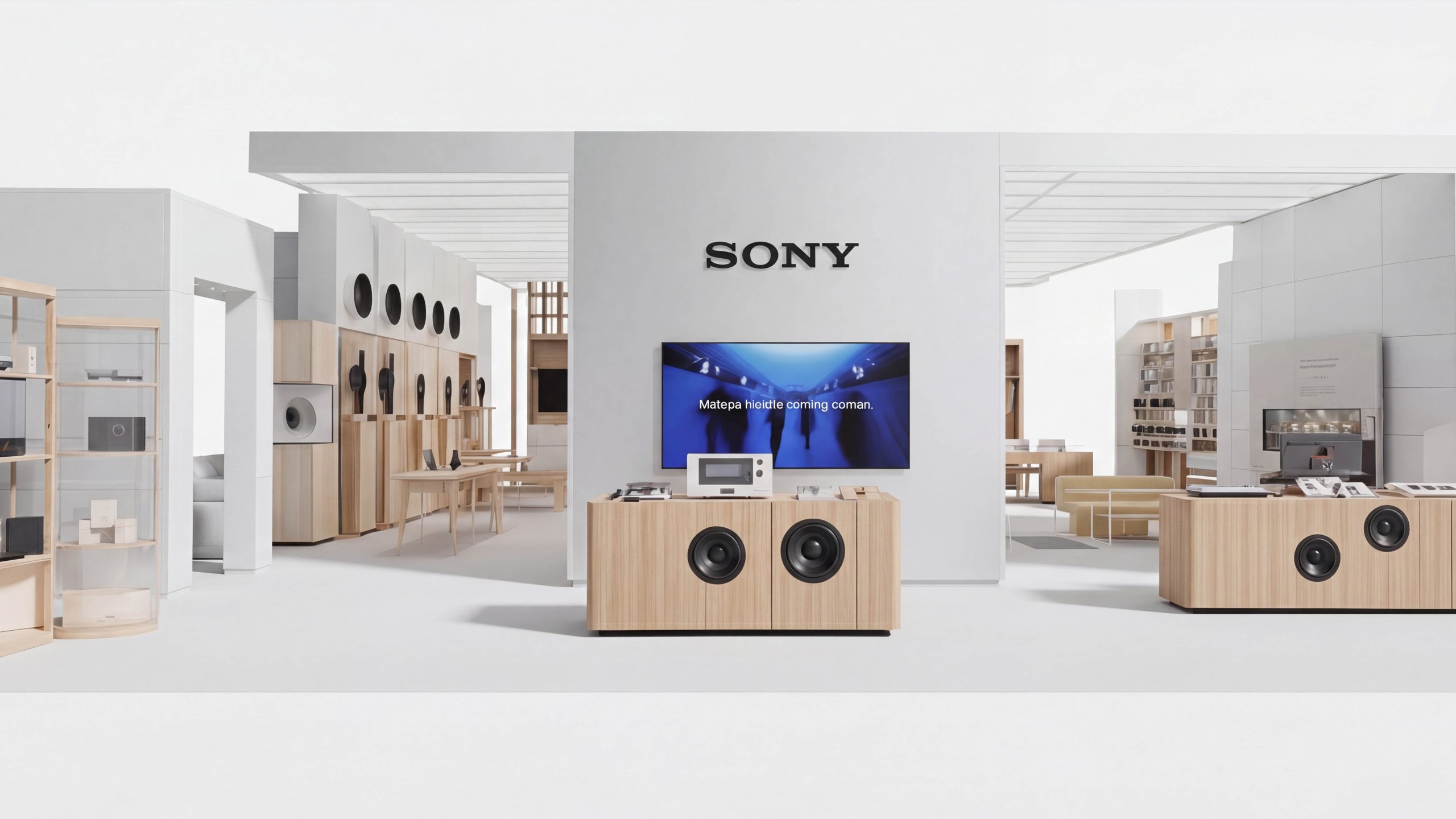
Façade and entrance: illuminated storefront signage plus corner blade signs create visibility from multiple sides; the first panel at the entrance combines a zone index, the day’s featured products and a service list (installments, trade-in, extended warranty). Zones and trial islands: five zones, covering mobile imaging, TV and display, audio, gaming, and wearables. Trial tables use a three-tier nameplate (highlights – operation – safety), with NFC/QR codes linking directly to specifications, sample images and listening demos, and pairing and update guides. Pricing and benefits: a unified price-tag template on end caps and shelf edges presents model, storage/power, price, membership and installments, trade-in subsidies and extended warranty in clear layers; water-resistance rating, battery life, charging power and sensor size appear side by side using fixed color bands and icons. Checkout and pickup: a “be prepared” checklist at the cashier prompts for invoices, data migration, activation and delivery/pickup booking; the pickup area is organized by number ranges and one-way circulation, with estimated wait times and the required verification documents displayed. After-sales and safety: service desk panels use a three-part format (request – documents – estimated time); AEDs, fire safety, evacuation and accessible routes use high-contrast templates, with secondary confirmation signs along long corridors and at corners.
Delivery and operation and maintenance mechanism
An integrated operating framework connects the signage asset register, template library and live data. Every sign has a unique ID, installation coordinates and maintenance history. Templates automatically generate price labels, featured-product cards, demo schedules and queue-management materials for local production and rapid replacement. QR codes link to current floor plans, specification sheets, system migration SOPs and emergency plans. Inspection checklists define frequency, tolerances, cleaning standards and illumination requirements. Deliverables include a sitewide wayfinding plan and sign location drawings, layout and icon guidelines, exploded assembly drawings and bills of materials, mounting heights and lighting specifications, operations and maintenance SOPs, and training resources. Designed for rapid rollout across cities and store formats, the system maintains clear information hierarchies, consistent legibility and a professional expression of the Sony brand over time.