


















Qingmei Future Insights
Circular Economy Brands: Designing AI-Enabled Global Circular Supply Chains
Circular Economy Brands: Designing AI-Enabled Global Circular Supply Chains
As the global environmental crisis deepens, the traditional linear economy and its "take, make, dispose" mindset face unprecedented challenges. The circular economy, a sustainable model that emphasizes recycling resources, minimizing waste, and maximizing value, has become an essential path for companies worldwide to transform. Rapid advances in AI provide strong technical support for building intelligent circular supply chains. Integrating AI deeply into circular brand building and supply chain management not only improves resource efficiency and reduces environmental impact, but also creates new business value and competitive advantage.
Strategic foundation of circular economy brand

The construction of a circular economy brand requires a fundamental rethinking of the logic of value creation. Unlike traditional brands that focus on product sales and market share, the core value of circular economy brands lies in the recycling of resources and the creation of environmental value. This brand concept requires companies to embody the principles of circular economy throughout the entire life cycle of product design, manufacturing, sales services, and recycling.
Repositioning a circular-economy brand means putting its core value proposition front and center. As consumers care more about the environment and sustainability, these brands must make environmental responsibility, resource efficiency, and social responsibility their defining marks. This positioning should show up not only in visual expression, but be proven and reinforced through concrete business practice.
Identifying and nurturing the right audience is key to the success of a circular economy brand. Early adopters tend to be consumers with strong environmental awareness and a sense of social responsibility, willing to pay a premium for sustainable value. As circular economy ideas spread and technology costs fall, mainstream consumers will gradually accept and choose circular products.
A clear value proposition must balance environmental benefit with commercial value. Circular-economy brands should highlight not only the social value of protecting the environment but also the functionality, economy, and convenience of their products. Only when circular products meet environmental standards while also delivering an excellent experience at a reasonable cost will they win broad market acceptance.
A circular-economy brand story should show the practice and the social impact behind it. By telling the full cycle of a product, from sourcing raw materials to recovering waste, the brand shows its efforts and results in advancing sustainability. Telling it as a story helps consumers understand the value and meaning of the circular economy.
Core AI Applications in Circular Supply Chains

AI applies across every dimension of the circular supply chain. In raw material management, big data analysis and machine learning optimize sourcing and allocation. Algorithms forecast shifts in demand, identify viable alternative materials, and optimize material combinations to maximize recycling efficiency.
In manufacturing, AI enables intelligent optimization of the production process. By monitoring and analyzing production data in real time, AI systems can pinpoint waste and tune parameters to reduce scrap. Predictive maintenance extends equipment life and lowers the frequency and cost of replacement.
At the product design stage, AI helps designers create products that better reflect circular economy principles. By analyzing material properties, usage patterns, and recyclability, AI can recommend the optimal design, ensuring recovery and reuse are considered from the very start.
In logistics and delivery, AI can optimize routes and delivery plans, cutting energy use and carbon emissions in transit. Intelligent dispatch systems can integrate forward and reverse logistics, improving efficiency and lowering total cost.
In waste management and recycling, AI is especially powerful. Computer vision can automatically identify and sort waste, improving the accuracy and efficiency of recycling. Machine learning can predict waste generation patterns and optimize collection schedules and resource allocation.
Intelligent waste identification and classification system
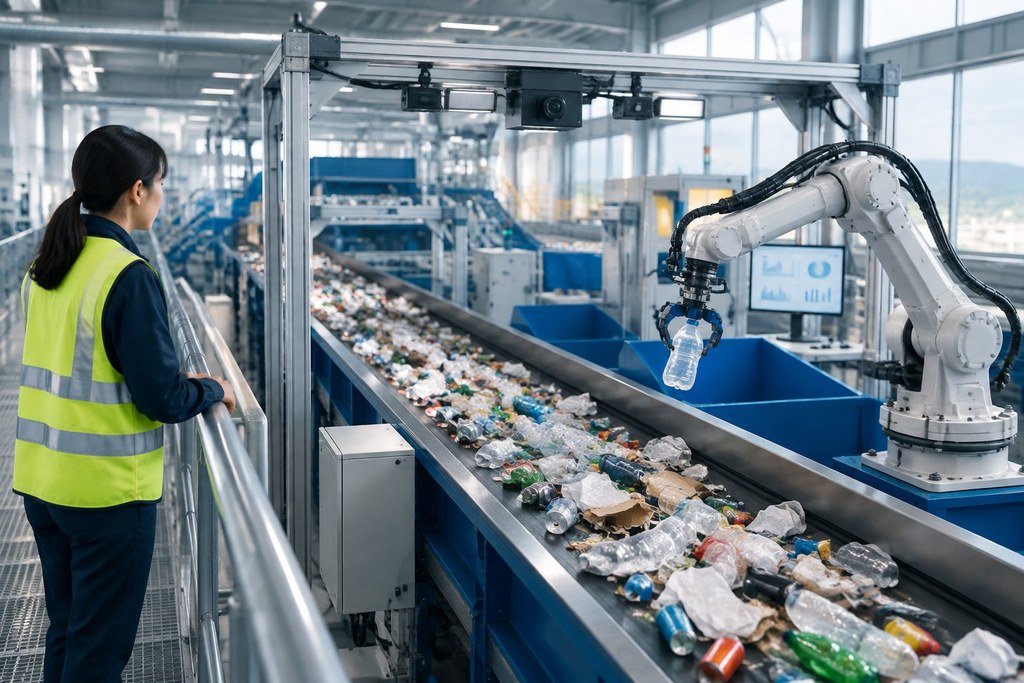
Intelligent identification and classification of waste is a key link in the circular economy supply chain. Traditional waste classification mainly relies on manual operations, which is inefficient and has limited accuracy. The introduction of AI technology has completely changed this situation, making large-scale and high-precision waste classification possible.
Computer vision for waste identification is now highly mature. Visual recognition systems trained with deep learning can accurately identify different types of waste, including plastic, metal, paper, and glass. Beyond material type, they can also assess material quality grades, providing precise guidance for downstream processing and recycling.
Combining multidimensional sensing technologies further improves recognition accuracy. Beyond visual recognition, systems can integrate weight sensing, spectral analysis, magnetic detection, and more to analyze waste characteristics from every angle. This multi-technology approach handles complex mixed waste and improves sorting precision and reliability.
Faster real-time processing allows intelligent sorting systems to run on high-speed production lines. Modern AI sorting systems identify waste and make sorting decisions in milliseconds, keeping pace with industrial production.
Adaptive learning lets the system continually improve its recognition. Through ongoing data collection and algorithm refinement, it learns new waste types, keeps pace with advances in materials, and grows more accurate over time.
Data standards and sharing mechanisms enable collaboration across systems. With unified waste identification standards and data formats, equipment from different manufacturers can interoperate, forming larger circular economy networks.
Predictive demand analysis and resource optimization
Predictive analysis is another important application area of AI in the circular economy. Through in-depth mining and pattern recognition of historical data, the AI system can predict future resource demand and supply changes, providing a scientific basis for the optimization of the circular economy supply chain.
Building a demand forecasting model requires integrating data from many sources. Historical sales, market trends, economic indicators, seasonality, and regulatory change all shape demand. AI uses machine learning to analyze these complex relationships and build accurate forecasting models.
Dynamic assessment of supply capacity is the foundation of efficient resource allocation. AI systems monitor the recycling network in real time, assessing the processing capacity and inventory levels of every node. By analyzing each link in the supply chain together, the system can identify potential bottlenecks and opportunities to optimize.
Inventory optimization algorithms can minimize inventory costs while meeting demand. For circular supply chains, inventory management is more complex, as it must balance stocks of both raw and recycled materials. AI algorithms can optimize this multi-tier structure and improve resource efficiency.
Risk assessment and response mechanisms make supply chains more stable. AI can identify risk factors, predict potential disruptions, and prepare responses in advance. This preventive approach reduces the impact of disruptions on the circular economy.
Dynamic pricing can use the price mechanism to balance supply and demand. AI systems can adjust the price of recycled materials in real time as conditions change, encouraging suppliers to recover more or buyers to consume less, and keeping the market in balance.
Global Coordination, Local Execution

The successful implementation of the circular economy requires finding a balance between global network coordination and localized execution. AI technology provides strong support for this multi-level coordination, allowing the global circular economy network to operate efficiently.
A global data platform is the infrastructure for network coordination. It integrates supply chain data from around the world, including raw material supply, production capacity, demand distribution, and waste generation. By analyzing this data at scale, AI can optimize how resources are allocated globally and raise overall efficiency.
Cross-regional coordination helps balance supply and demand across regions. Some regions are major sources of raw materials, while others are major consumer markets. AI systems can coordinate the flow of resources between them, optimizing transport routes and distribution plans.
Local adaptation strategies must account for each region's specific conditions. Laws and regulations, cultural habits, infrastructure, and economic development all shape how a circular economy can work. AI systems need enough flexibility to adapt to these regional differences.
Balancing standardization and customization is key to running a global network. Unified technical standards and operating procedures ensure systems in different regions can interconnect. At the same time, some customization must be allowed to meet local needs.
Real-time monitoring and feedback keep the global network running in sync. Through IoT devices and sensor networks, AI systems monitor global supply chain operations in real time, detecting issues early and making adjustments.
Blockchain technology and transparency construction
The combination of blockchain technology and AI provides a revolutionary solution for the transparency of the circular economy supply chain. The decentralization and non-tampering characteristics of the blockchain combined with the intelligent analysis capabilities of AI can establish a highly transparent and credible circular economy ecosystem.
A full product lifecycle traceability system is central to transparency. Each product receives a unique digital identity that records its entire journey, from sourcing and manufacturing to sale, use, and recycling. Blockchain keeps these records authentic and tamper-proof; AI analyzes the data and extracts its value.
A robust supplier certification and evaluation process helps build a trusted supplier network. By recording suppliers' track records, certifications, and compliance on a blockchain, AI systems can rate suppliers and assess risk, providing a sound basis for procurement decisions.
Well-designed engagement and incentives raise participation in the circular economy. Blockchain can record sustainable actions such as sorting waste correctly or joining recycling programs. AI then calculates corresponding green points and rewards consumers for them.
Quantifying and verifying environmental benefits strengthens brand value. Using blockchain-recorded data, AI systems can calculate the impact of circular-economy activities, such as carbon emissions reduced, resources saved, and waste avoided. These measured results give brand communications credible support.
Automated compliance reduces the complexity of compliance management. AI systems can monitor supply chain activity for compliance and detect and report violations promptly. The transparency of blockchain lets regulators see a company's circular economy practices in real time.
Intelligent guidance for consumer participation
Consumers are key to the success of the circular economy. Their choices directly shape its outcomes. AI can increase participation and drive behavior change through intelligent guidance and incentives.
Personalized sustainability advice is built on deep analysis of consumer behavior. By analyzing purchase history, usage patterns, and waste generation, AI provides each consumer with tailored recommendations. Not generic slogans, but specific, practical steps.
Smart recycling guidance helps consumers dispose of waste correctly. Using image recognition and natural language processing, consumers can take a photo or ask by voice to get guidance. The system explains how an item should be sorted, where to recycle it, and what to watch for.
Incentives for behavior change should draw on behavioral economics. AI systems can analyze consumer behavior patterns and design matching incentive strategies: gamification to make participation more engaging, social features to strengthen motivation, and rewards to offer tangible benefits.
Visualizing environmental impact shows consumers the value of their actions. AI systems can calculate and display the concrete effects of sustainable behavior: resources saved, emissions reduced, and environmental value created. This visual feedback reinforces a sense of achievement and motivates continued participation.
Community platforms foster exchange and interaction among consumers. AI connects people with similar environmental values, building communities where they share experience and knowledge. This collective approach turns individual action into broader social impact.
Cost-benefit analysis and business model innovation

To succeed, the circular economy must prove it is commercially viable. AI helps businesses run precise cost-benefit analyzes, explore new business models, and deliver both economic and environmental returns.
A full-cost accounting system must reflect the complete cost structure of the circular economy. Beyond direct material and operating costs, it must account for environmental, social, and long-term costs. AI systems can build sophisticated cost models that give decision-makers a complete view of costs.
More granular return analysis helps assess the value of circular economy projects. AI systems can simulate the returns of different investment options, account for risk and uncertainty, and provide a sound basis for investment decisions.
Exploring and validating new business models is a key direction for circular economy innovation. Product-as-a-service, the sharing economy, and the platform economy may all find applications in a circular economy. AI can help companies assess the feasibility and profit potential of these models.
Finding opportunities to restructure the value chain requires a close analysis of the traditional business model. AI systems can identify inefficiencies and room for improvement across the value chain, and propose a new structure. That structure should account not only for efficiency, but also for environmental and social value.
Optimizing partnerships improves the overall efficiency of a circular economy network. AI systems can analyze each partner's capabilities and resources, optimize how partnerships are structured, and allocate resources for maximum value.
Technical Challenges and Solutions

Building AI-supported circular supply chains inevitably involves technical challenges. These must be addressed through technological innovation and system optimization.
Data quality and standardization are foundational challenges. The circular economy involves many participants and data sources, and inconsistent quality and standards undermine AI performance. Solutions include data quality management systems, unified data standards, and data cleaning and validation processes.
System integration and interoperability are key challenges in implementation. Devices and systems from different vendors must integrate and work together seamlessly. Solutions include open standards, unified interface specifications, and modular system architecture.
Algorithmic transparency and explainability are essential for building trust and meeting regulatory requirements. AI decision-making must be understandable and explainable. Solutions include explainable AI algorithms, decision traceability, and algorithm audit capabilities.
Privacy and data security demand serious attention. Circular-economy supply chains involve large volumes of sensitive data and require strict safeguards. Solutions include privacy-preserving technologies, data encryption, and access controls.
Scalability and performance optimization are the technical foundation for large-scale deployment. As circular economy networks grow, systems must handle larger data volumes and more complex computation. Solutions include cloud architecture, distributed processing, and algorithm optimization.
Policy Support and Regulatory Frameworks

AI-supported circular economy development requires matching policy support and regulatory frameworks. Government guidance and regulation are essential to the healthy growth of the circular economy.
Incentive policies should encourage companies to invest in the circular economy and AI. Tools include tax incentives, subsidies, and procurement preferences. These policies should match the level of technological development and market maturity, avoiding both over- and under-incentivizing.
Setting regulatory standards means balancing support for innovation with control of risk. For AI applications, this calls for technical standards and safety guidelines. For circular economy practices, it calls for systems to evaluate and certify outcomes.
International cooperation helps coordinate the development of the global circular economy, including unified technical standards, rules for data sharing, and mechanisms for cross-border coordination. This cooperation prevents technological fragmentation and makes the global circular economy more efficient.
Laws and regulations need to evolve with the circular economy and AI. This includes establishing and refining legal frameworks such as data protection laws, AI liability laws, and circular economy promotion laws.
Public education and awareness are the social foundation of effective policy. Governments need to do more to explain the circular economy and AI, raising public understanding and encouraging participation.
Circular brands and AI-enabled global supply chain loops point to the future of sustainability. This model helps address environmental challenges and creates new value and competitive advantage for businesses. With AI applied in depth, the circular economy can achieve greater efficiency, better outcomes, and larger scale. But the transition requires technology, new business models, policy support, and public participation to move together. Only through shared effort can an AI-enabled circular economy reach its full potential and help build a sustainable future.